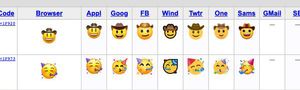
I would wager that the most common type of image in the world today, in terms of sheer volume, are the beloved emoji. People use literally billions of them Opens in a new window everyday.
Full assistive technology default support for emojis is not there yet Opens in a new window, but with the help of ARIA, we can make them accessible! 😁
1. Take your unicode emoji…
😐2. … wrap it in a <span> tag…
<span>🙂</span>3. … give it a role attribute, with a property of img (so that screen readers know that it's an image, and not just a character it can't make sense of)…
<span role='img'>🙃</span>4. … give it an aria-label attribute (so that screen readers have something to read as the description)…
<span role='img' aria-label='not sure what, that`s the next step'>😊</span>5. … find the emoji in the Unicode emoji listings Opens in a new window and use the CLDR Short Name as the label.
<span role='img' aria-label='smiling face with halo'>😇</span>Now, I know what you're thinking at this point: "There's got to be an API or something so that I can pull the CLDR Short Names and automate the process, right?"
And to that I say, isn't it cool when you find out that the world needs your help?
And also, please let me know if you're working on this - I'd love to see it done!